The Biology of Fatherhood: How Men’s Hormones Change
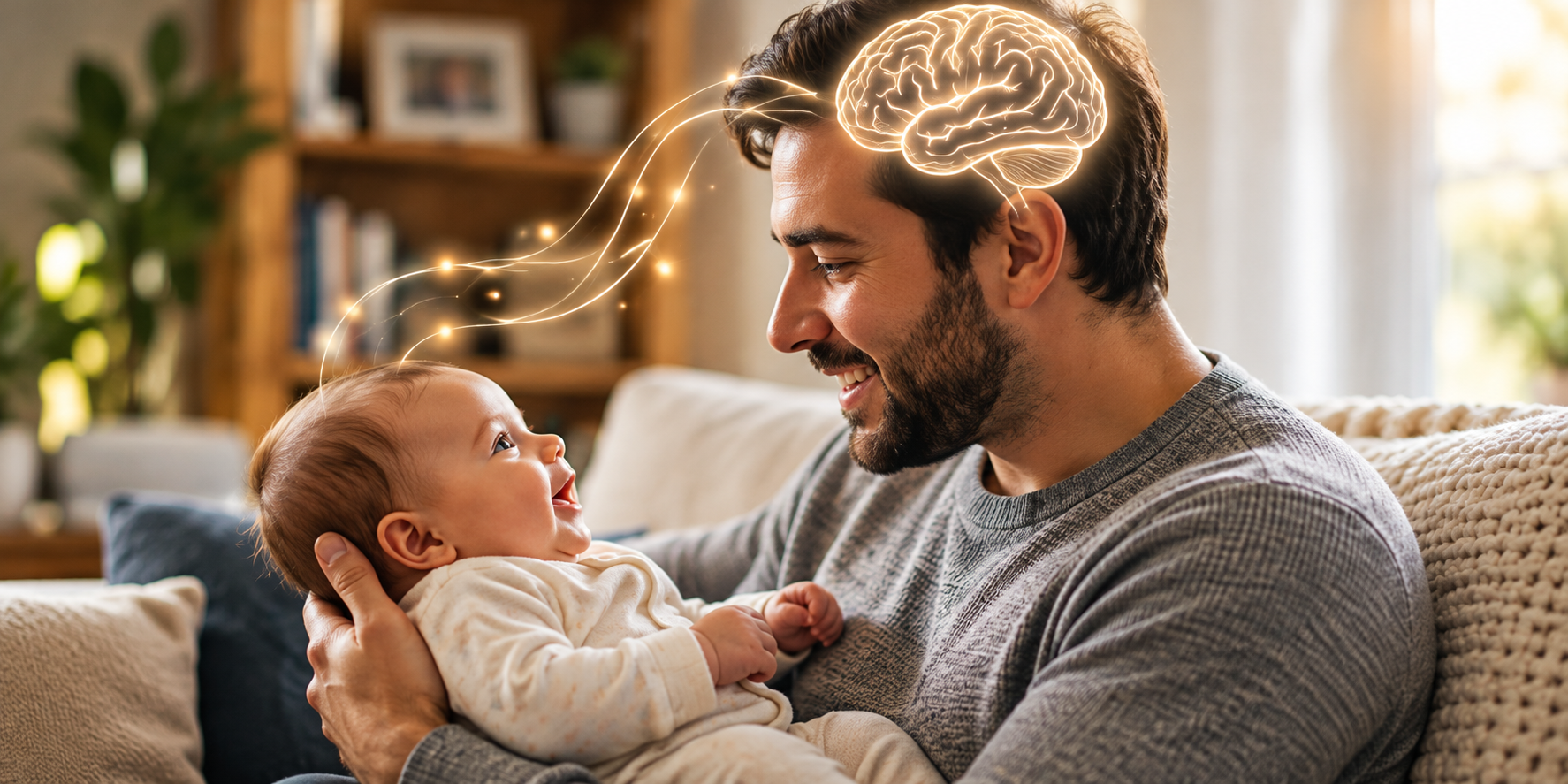
What the research shows about testosterone, oxytocin, and the changes that may begin before birth.
Pregnancy changes a woman’s body in extraordinary ways. But research suggests that the transition to fatherhood can involve biological changes in men, too.
And some of those changes may begin months before the baby arrives.
The Short Version
Research suggests that the hormonal transition to fatherhood may begin before birth. In a 2025 longitudinal study, men with lower testosterone and vasopressin during pregnancy went on to report greater involvement with their partners and infants. These findings suggest that paternal hormones may be connected to the developing caregiving relationship, although they cannot show that lower hormone levels cause greater involvement.
- Changes may start during pregnancy. Expectant fathers have shown hormonal differences from nonfathers as early as the middle of pregnancy.
- Testosterone and fatherhood may run in both directions. Fatherhood is linked with lower testosterone, and lower prenatal testosterone has been linked with later involvement.
- Hormones work together. Testosterone and estradiol may matter more in combination than on their own.
- Oxytocin may rise, but it isn’t a bonding switch. Higher levels haven’t consistently predicted closer father-baby relationships.
- Prolactin isn’t just for breastfeeding. It has been linked with fathers’ responses to infant cues and with sympathetic pregnancy symptoms.
- Cortisol findings are mixed. No single stress-hormone pattern reliably describes expectant fathers.
- Partners’ hormones may move together. Some studies suggest expectant parents’ hormone levels can shift in step.
- The father’s brain may change, too. Imaging studies show structural and functional changes in first-time fathers.
- Some differences may fade. Early research suggests some differences may diminish as children grow.
- Hands-on care matters. Hormones don’t decide what kind of father someone becomes. Time, presence, and caregiving do.
It May Begin Before Birth
When we talk about hormones during pregnancy, we usually talk about the pregnant woman.
Estrogen and progesterone rise. Prolactin helps prepare the breasts for milk production. Oxytocin plays important roles in labor, birth, and breastfeeding. After delivery, the body goes through another major hormonal transition.
These changes are well documented, and their physical effects can be profound.
Men do not experience the endocrine demands of gestation or childbirth. Yet researchers have found that their hormonal systems may still respond to the transition into parenthood, and sometimes well before the baby is born.
One of the most striking findings comes from a 2025 study by researchers at Emory University. They followed 51 first-time expectant fathers from about four to five months of pregnancy through four months after birth, measuring testosterone, oxytocin, vasopressin, and cortisol at four points. They compared these men with 57 men who were not becoming fathers.
At the very first measurement, in the middle of pregnancy, the expectant fathers already had significantly lower testosterone and vasopressin than the comparison group.
And those prenatal hormone levels appeared to matter later on:
- Time with the mother: Lower testosterone during pregnancy predicted more time spent with their partners at one and four months postpartum.
- Engagement with the baby: Lower testosterone in late pregnancy predicted more positive engagement with the infant at about one month postpartum.
- Vasopressin: Lower prenatal vasopressin was also associated with greater paternal involvement after birth.
In other words, something in these men’s biology appeared to be shifting before they had ever held their babies, and those shifts were connected to how involved they became afterward.
One possibility is that men who are already more emotionally invested in the pregnancy experience hormonal changes alongside that growing involvement.
What makes these findings particularly fascinating is the possibility that the biological transition into fatherhood begins long before the first diaper change.
Source: Rilling et al., 2025
Testosterone: A Two-Way Street
Testosterone is commonly associated with sexual development, reproductive function, and muscle mass. It also participates in complex behavioral and physiological processes.
Lower testosterone in fathers is one of the most consistently studied findings in paternal hormone research.
Fatherhood and falling testosterone
In a 2011 longitudinal study of 624 men in the Philippines, researchers measured testosterone in young single men and then again about four and a half years later.
Men who became partnered fathers during that time experienced substantially greater testosterone declines than men who remained single and without children. Among the new fathers, waking testosterone declined by a median of 26%, and evening testosterone by 34%.
Fathers who reported spending at least three hours a day providing childcare also had lower testosterone than fathers who were less involved.
But here’s an especially interesting detail: the single men who started out with higher testosterone were actually more likely to go on to become partnered fathers. After becoming fathers, their testosterone declined.
The findings reveal a fascinating relationship between testosterone and fatherhood, one that appears to change as men move from finding a partner to raising a child.
Can testosterone change before birth?
The evidence suggests it can.
A 2015 study followed 29 expectant couples through pregnancy, measuring testosterone, cortisol, estradiol, and progesterone at several points. While the pregnant participants had substantial increases in these hormones, the expectant fathers showed significant decreases in testosterone and estradiol.
From the Research
The 2025 Emory study adds an important twist. Those researchers did not find a steady decline in testosterone across their four measurements. Instead, the expectant fathers were already lower than nonfathers at the first visit, in mid-pregnancy.
The researchers suggest that these hormonal differences may reflect something particularly fascinating: a man’s biology beginning to adapt to his new role as a father, even before his baby is born.
Why “two-way street”? The 2011 study found that men with higher testosterone were more likely to become partnered fathers, but their testosterone declined after they became fathers. The 2025 Emory study added another interesting connection: expectant fathers with lower testosterone tended to be more involved with their families after birth. Together, these findings suggest that testosterone and fatherhood may be connected in more than one way, with hormonal changes accompanying different stages of becoming and being a father.
Testosterone may also be connected to parents’ emotional well-being. A 2017 study of 149 couples found that fathers with lower testosterone reported more depressive symptoms after birth, while mothers whose partners had higher evening testosterone also reported more depressive symptoms. The findings reveal another interesting relationship between paternal hormones and the experiences of both parents during the postpartum period.
Sources: Gettler et al., 2011; Edelstein et al., 2015; Rilling et al., 2025; Saxbe et al., 2017
Estradiol: Hormones Work Together
Estradiol is a form of estrogen. Most people think of it as a “female” hormone, but men produce it too, partly by converting testosterone. In fact, estradiol is the most abundant and biologically active form of estrogen in men.
In the 2015 study of expectant couples, men’s estradiol declined during pregnancy along with their testosterone.
A 2022 study of 73 first-time fathers in the Netherlands raised an especially interesting possibility. Testosterone dropped substantially from pregnancy to the postnatal period. But when researchers looked at how fathers interacted with their two-month-old babies, no single hormone told the full story. The combination of testosterone and estradiol did. Among fathers with high estradiol, higher testosterone was linked with less sensitive parenting.
This was an exploratory finding and needs to be replicated. But it points to something important: hormones don’t act alone. They interact with one another in ways that studying one hormone at a time can miss.
Sources: Edelstein et al., 2015; Bakermans-Kranenburg et al., 2022
Oxytocin: The Bonding Hormone
Oxytocin is often called the “love hormone,” and for good reason. It plays an important role in social bonding, trust, and attachment. In fathers, its effects may go beyond feelings of affection. Research suggests oxytocin can influence how men respond to their children, how rewarding those interactions feel, and even how fathers and babies engage with one another.
From the Research
A fascinating 2017 Emory University study examined what happened in fathers’ brains when they received oxytocin and viewed photographs of their own toddlers. Researchers found increased activity in brain regions involved in reward, motivation, attention, and empathy.
In other words, oxytocin may help make a father’s own child especially meaningful and rewarding to him. The findings offer an intriguing glimpse into the biology of paternal attachment.
Oxytocin may also influence how fathers respond to their babies’ distress. In a 2022 study of 70 first-time fathers, researchers administered oxytocin and measured brain activity while the men listened to infant crying. They observed reduced activity in the amygdala, a region involved in processing emotionally significant and potentially threatening stimuli. The researchers suggested this response may be connected to reduced anxiety or aversion when hearing a baby cry.
And the relationship may extend beyond the father himself. In a 2012 experiment involving 35 fathers and their five-month-old infants, administering oxytocin increased certain behaviors associated with social engagement. Their babies also showed changes in social attention, reciprocity, and physiological responses during the interactions.
What’s particularly fascinating is that changes in the father’s hormonal activity were accompanied by changes in the baby’s responses, too.
The findings offer a glimpse into how closely connected the biological and behavioral experiences of fathers and infants can be.
Together, these studies suggest that oxytocin may help shape the experience of fatherhood itself. It may influence how fathers process their babies’ signals, how motivated they are to engage, and how their interactions unfold. Those interactions may, in turn, influence the father’s own hormonal responses.
What happens when fathers interact with their babies?
Research suggests that the relationship between oxytocin and father-infant interaction may work in both directions. Hormones may influence how fathers respond to their babies, while the interactions themselves may also influence hormonal activity.
A systematic review of 17 studies found associations between parent-infant contact and oxytocin levels. Among fathers, oxytocin was especially linked with physical and stimulating interactions, including playful movement and touch.
Holding their babies, responding to cries, talking, playing, and sharing everyday moments of care all provide opportunities for fathers to build closeness and familiarity with their children.
The everyday experiences that help fathers and babies connect may also be part of the biological changes associated with fatherhood.
Sources: Rilling et al., 2025; Bakermans-Kranenburg et al., 2022; Scatliffe et al., 2019
Prolactin and “Sympathetic Pregnancy”
Prolactin is best known for its role in breast milk production. But it is also present in men, where it participates in reproductive and other physiological processes.
A study published in 2000 examined hormone levels in expectant and new fathers and their responses to infant-related cues, like the sound of a baby crying. Researchers found elevated prolactin and cortisol in the weeks shortly before birth, along with links between prolactin levels and men’s responses to infant cues.
That same study touched on something many families have noticed for generations: expectant fathers who seem to experience pregnancy symptoms of their own.
Is “sympathy weight” real?
There’s a name for it. Couvade (koo-VAHD) is the term for pregnancy-like symptoms in expectant fathers, including nausea, appetite changes, weight gain, fatigue, mood changes, and even abdominal discomfort.
Pregnancy changes daily life for both parents. Stress, disrupted sleep, new routines, and shared meals can all shape how an expectant father feels.
The same 2000 study hinted at something more. Among its small group of expectant fathers, the men who reported more of these symptoms also tended to have higher prolactin levels.
That’s what makes this early finding so interesting. A father’s physical experience of pregnancy may involve more than a changing routine. His own biology may be shifting alongside his partner’s.
Prolactin, long tied to motherhood and lactation, may have a role in the transition to fatherhood, too.
Source: Storey et al., 2000
Cortisol: What Happens to the Stress-Response System?
Cortisol is involved in the body’s response to stress. It also helps regulate metabolism, immune function, and the normal sleep-wake cycle.
With everything that changes before and after a baby arrives, you might expect a father’s cortisol to climb. The research tells a more surprising story.
A 2001 study found that expectant fathers actually had lower average cortisol than men who were not becoming fathers, with a rise shortly before birth in some participants. The 2025 Emory study found no significant overall difference between fathers and nonfathers.
Cortisol can also respond to interactions with a baby. Studies have found that it can rise when fathers hear their infant crying and fall when they hold their newborns, offering a glimpse into how a father’s body responds to his child in real time.
Sources: Berg & Wynne-Edwards, 2001; Rilling et al., 2025; Bakermans-Kranenburg et al., 2019; Bakermans-Kranenburg et al., 2022
Vasopressin: Another Hormone Worth Watching
Vasopressin is best known for helping the body regulate water balance and blood pressure. It also acts in the brain, where researchers have studied its involvement in social behavior, including territorial and competitive behavior in some animals.
The 2025 Emory study found that expectant fathers had lower vasopressin levels than nonfathers beginning in mid-pregnancy. Even more interesting, fathers with lower prenatal vasopressin tended to report greater involvement with their babies after birth.
Researchers have proposed that lower vasopressin and testosterone may be part of a biological shift toward greater investment in parenting. In other words, as a man prepares to become a father, changes in these hormones could accompany changes in how he directs his time, attention, and energy toward his growing family.
That’s what makes these findings so fascinating: a father’s biology may begin preparing for caregiving before his baby is even born.
Hormones in Sync: Expectant Parents Together
One of the more fascinating questions in this research is whether partners’ hormones change together.
Researchers call this hormonal synchrony, and several studies have found connections between expectant parents’ hormone patterns during pregnancy.
A 2017 study found that fathers whose testosterone levels changed more closely in step with their partners’ reported greater investment, commitment, and satisfaction in their relationships after birth.
A 2024 review brought together 13 studies examining hormonal synchrony during pregnancy and after birth. Researchers found evidence of linked cortisol, testosterone, and other hormone levels, although the patterns differed depending on the hormone and stage of parenthood.
The findings raise an intriguing possibility: as couples prepare to become parents, their biological changes may be connected in ways we’re only beginning to understand. The transition to parenthood may be something partners experience together not just emotionally, but hormonally, too.
Sources: Saxbe et al., 2017 (Fathers’ decline in testosterone and synchrony with partner testosterone); Daneshnia et al., 2024
How Long Do These Changes Last?
This is one of the most interesting open questions in paternal hormone research. Do the hormonal changes associated with becoming a father last beyond pregnancy and early infancy? Or do they shift again as children grow and parenting changes?
A new study published online in October 2026 offers a fascinating look at what happens next. Researchers from Emory University followed first-time fathers into their children’s early years, examining hormone levels, caregiving, and relationships.
By one and two years postpartum, fathers and nonfathers no longer showed significant differences in testosterone, oxytocin, vasopressin, or cortisol after accounting for relevant factors.
But when researchers looked at differences among the fathers themselves, they found something interesting: individual hormone levels were still associated with how fathers experienced and engaged in parenting.
At one year postpartum, fathers with lower testosterone tended to report more positive engagement and less frustration with their children, while those with higher cortisol reported less positive engagement. By two years, fathers with higher oxytocin reported stronger attachment to their children.
These findings suggest that some hormonal changes associated with becoming a father may be especially noticeable during pregnancy and early infancy, while the relationships between hormones, caregiving, and attachment continue into the toddler years.
Fatherhood may not produce one permanent hormonal state. Instead, the biology of fatherhood may continue to shift as fathers and their children grow together.
Source: Rilling et al., 2026
Beyond Hormones: The Father’s Brain
Hormones are only one part of the story. Researchers are also studying how fathers’ brains change.
A 2023 study used MRI scans to follow first-time fathers in Spain and the United States from before birth into the postpartum period. In both groups, fathers showed small reductions in cortical volume, especially in brain networks involved in social thinking and visual processing. A comparison group of nonfathers did not show similar changes.
Mothers show similar changes, and researchers think they may reflect the brain fine-tuning itself for parenthood.
A 2024 follow-up study added another interesting layer. Fathers who experienced greater reductions in cortical volume also tended to report more involvement in caregiving. But those same changes were associated with more sleep problems and symptoms of psychological distress, suggesting that the brain’s transition into parenthood may reflect both adaptation and the demands of caring for a newborn.
And the changes aren’t just structural.
A 2026 study from the Emory team found that, after becoming fathers, men showed increased activation in brain regions involved in reward and motivation when anticipating infant images, along with increased responses in empathy-related regions when viewing the images themselves. These changes were not observed in nonfathers.
Taken together, these studies point to a remarkable idea: fatherhood may influence both the structure of the brain and how it responds to babies. A father’s brain may be adapting to recognize, respond to, and find reward in caring for his child.
Sources: Martínez-García et al., 2023; Saxbe & Martínez-García, 2024; Lee & Rilling, 2026
The Emotional Side of Fatherhood
Biology is only one part of becoming a father. The emotional transition can be just as profound, bringing changes to relationships, identity, and mental well-being.
For a deeper look at this experience, read The Emotional Weight of Fatherhood, and Bret’s personal perspective in Becoming Dad: Supporting Your Wife and Yourself to Become The Dad You Want To Be.What Helps: The Biology of Showing Up
The most hopeful thread running through this research is that a father’s connection with his child is not fixed by his hormone levels.
In the 2011 Philippines study, the fathers most involved in daily childcare had the lowest testosterone. Oxytocin research points to physical, playful interaction. The Emory findings link early hormonal shifts with time spent with both partner and baby.
Some of the most compelling evidence comes from fathers who never experienced a partner’s pregnancy at all. A 2014 study of gay fathers raising babies as primary caregivers found that their brains responded to their infants in ways similar to mothers’. Across the fathers studied, more time spent in hands-on caregiving was linked with stronger connections between brain regions involved in emotional responsiveness and understanding others.
That matters for adoptive fathers, stepfathers, and any parent who didn’t carry the baby. The capacity to adapt to caregiving appears to grow through the caregiving itself.
Little Ways to Build a Big Connection
- Skin-to-skin contact. Holding the baby against your bare chest is not just for mothers.
- Hands-on routines. Bath time, diaper changes, burping, and bedtime are all chances to connect.
- Responding to cries. Soothing a crying baby, even when it’s hard, builds familiarity and confidence.
- Play and touch. Gentle movement, talking, singing, and silly faces all count.
- Being present with your partner. Time spent supporting the mother is part of fatherhood, too.
Some fathers feel an overwhelming connection during pregnancy or right after birth. Others build that relationship gradually, through the everyday work of care. Both are normal. A slower start doesn’t mean something is hormonally wrong.
Biology may take part in that process. But so do presence, consistency, experience, and love.
Sources: Gettler et al., 2011; Scatliffe et al., 2019; Rilling et al., 2025; Abraham et al., 2014
We’re here. Keep going.
Sources & Further Reading
Proceedings of the National Academy of Sciences (PNAS): Gettler et al. (2011), Longitudinal evidence that fatherhood decreases testosterone in human males
American Journal of Human Biology: Edelstein et al. (2015), Prenatal hormones in first-time expectant parents
Hormones and Behavior: Rilling et al. (2025), Hormonal changes in first-time human fathers in relation to paternal investment
Philosophical Transactions of the Royal Society B: Bakermans-Kranenburg et al. (2022), Is paternal oxytocin an oxymoron? Oxytocin, vasopressin, testosterone, oestradiol and cortisol in emerging fatherhood
Child Development Perspectives: Bakermans-Kranenburg et al. (2019), Birth of a Father: Fathering in the First 1,000 Days
Evolution and Human Behavior: Storey et al. (2000), Hormonal correlates of paternal responsiveness in new and expectant fathers
Mayo Clinic Proceedings: Berg & Wynne-Edwards (2001), Changes in testosterone, cortisol, and estradiol levels in men becoming fathers
International Journal of Nursing Sciences: Scatliffe et al. (2019), Oxytocin and early parent-infant interactions: A systematic review
Hormones and Behavior: Saxbe et al. (2017), High paternal testosterone may protect against postpartum depressive symptoms in fathers, but confer risk to mothers and children
Hormones and Behavior: Saxbe et al. (2017), Fathers’ decline in testosterone and synchrony with partner testosterone during pregnancy predicts greater postpartum relationship investment
Clinical Child and Family Psychology Review: Daneshnia et al. (2024), Do parental hormone levels synchronize during the prenatal and postpartum periods?
Cerebral Cortex: Martínez-García et al. (2023), First-time fathers show longitudinal gray matter cortical volume reductions: evidence from two international samples
Cerebral Cortex: Saxbe & Martínez-García (2024), Cortical volume reductions in men transitioning to first-time fatherhood reflect both parenting engagement and mental health risk
Journal of Neuroendocrinology: Lee & Rilling (2026), The transition to human fatherhood involves increased brain activation to infant stimuli in regions involved with reward and motivation
PNAS: Abraham et al. (2014), Father’s brain is sensitive to childcare experiences
Psychoneuroendocrinology: Rilling et al. (2026), The transition to fatherhood beyond early infancy
JAMA: Garfield (2025), What is paternal perinatal depression?